

Kombucha 101 - Heat Sources

This is an additional part to the Kombucha 101 series.

In the previous parts we have concentrated on all the important ingredients which are integral parts of Kombucha (Water, Tea, Sugar and Scoby), as well as the Fermentation process. We have also taken into account the brewing vessels, and their influence on the final result.
Still, there is one more aspect which was left out. And it is also quite important, as it influences how Kombucha tastes, but that influence happens on a more subtle (but still noticeable) level.
So, let's have a look at different heat sources which can be used for cooking water for Kombucha.
And by heat source we mean the various types of stoves and other heating devices.
Most people do not pay much attention to the heat source when they are cooking water for tea, but what is used plays a big role, and we are not talking about flavor alone.
You can have the best spring water, the best tea, organic unrefined sugar, and still it might not matter that much, when you use the wrong heat source to brew the initial tea.
There are many heat sources which can be, and which are used for cooking water for tea.
Wood-burning ovens, charcoal ovens, gas stoves, electric stoves, induction stoves, and/or even a microwave.
Each one of them has it's own characteristics and each one of the influences the final product, be it just water for tea (or even the entire meal which is cooked on top of them).
Taking all the subtle flavor and energetic nuances, the best heating source always was, and still is, the wood burning stove or oven.
Anyone who grew up with a wood burning stove can tell you that the best tasting meals were cooked with the help of burning wood.

If you ever tried a freshly baked bead which came from a wood burning oven, you will know that nothing beats the flavor and texture of it. If you ever tasted a pizza which came out of wood burning oven, you can attest that it was the best pizza by far. No other oven will give you those results. The heat and the energy which is released by burning wood is unmistakable. Not to mention the natural smell which is also a big part of the whole process.
All those subtle aspects will naturally affect the water being heated or cooked for Kombucha.
Unfortunately, wood burning ovens are nowadays quite uncommon, so unless you are very lucky to have one of those ovens, the chances are quite slim that you would use one of them to heat the water for tea (and Kombucha).
Plus, it would be quite unpractical to use a stove like that just to cook some water.
A similar, but not so optimal heat source would be a charcoal oven. This is also not commonly used, although in China people have small charcoal stoves, like the one on the pic below.
We use this one once in a while for our outdoor tea ceremonies.

Those little ovens are great for heating up water for tea, but they would be not practical for Kombucha making.
The most common heat source by far is the natural gas.

Gas stoves are still quite popular and commonly used. Water, or any food cooked with the help of natural gas is quite good, as the water structure remains unchanged, as seen on the picture (*) below,

The flavor is also not affected. Plus it's easy to use..
Water heats up fast, and when you turn the burner off, you can leave the pot on top without worrying about overcooking.
Energetically, we would place natural gas right after the natural wood.
There is also propane gas which people use, when they do not have a natural gas hooked up to their houses, or to their business. Although, propane gas is not as clean as natural gas, but it is still a better option than all the rest of which we will cover next.
Electric stove is kind of between the good and bad territories. It is not as good as gas stove, but still far better than the last two choices which we will discuss next. It can heat up the water quite fast, and the water structure remains almost unchanged, as seen in the picture (*) below:
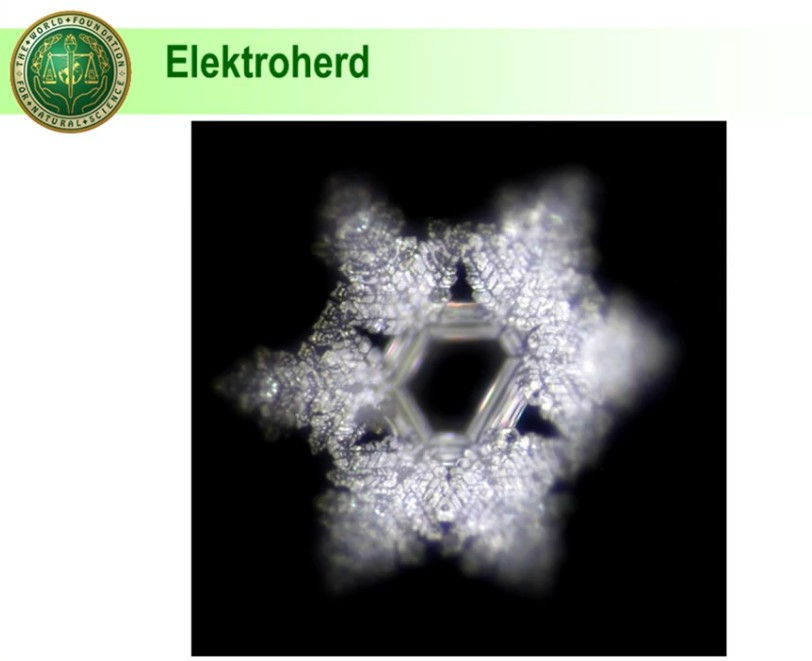
The subtle differences can be better detected in cooked foods than in cooked water. Foods cooked on electric stoves taste different than when cooked on gas stoves. They have an "off" flavor. And that is one of the reasons why gas stoves are preferred in gastronomy over electric stoves. Another reason is that you can't just turn off the burner and leave the pot (with water or food) on, as it will continue to cook.
Of course, a lot of people might not have the access to natural gas, and electric stoves might be the only option. That is also the option for tea ceremonies when people use the electric water water kettles, like the one below.

And now we come to the two worst choices, and each one of them is a big NO for us.
So, we would not drink the tea, nor Kombucha, which was prepared by anyone of those two ovens.
The first one is a microwave oven. Luckily because of its size people can not heat up larger amounts of water inside. They might heat up water for a tea cup or so but not a couple of liter water to make tea for Kombucha.
Microwaves have not only thermal but also biological effects on water and on foods in general.
And that is not a good influence.
To find out more about it, please check this article on the website of The World Foundation for Natural Science.
Here is the comparison of water sediment pattern from that article.

The sediment picture from a microwave is unrecognizable, as compared to the other two.
Another great article and a comparison of gas-heated water vs microwave heated water can be found on Cushla Tea Company's website in the article titled "The Impact of Microwave Water on Tea and Coffee".
Here's just a quote from that article:
"On the other hand, microwave water for tea can be unpredictable and inconsistent. The microwave heats water unevenly, which can cause some areas to be overheated while others remain under-heated. This can result in a tea or coffee that has an inconsistent taste and aroma. Additionally, microwaved water can also cause the loss of essential oils and volatile compounds that contribute to the flavor and aroma of the tea or coffee."
And finally the most "sneaky" (and heavily pushed and promoted, especially here in Europe) heat source is the induction oven.
This one not only changes the crystal structure of water heated (alone or inside foods), but it also creates strong radiation fields around the cooking surface. And those fields have a negative effect on the people standing next to those stoves.
Below is the picture of the crystal structure of water heated on the induction oven.
It is quite distorted, as can be seen on the picture (*) below:

For a better comparison, here are the same pictures (*) side by side. Gas, electric and induction.

That is quite a difference!
Here is another comparison of the structure of a water drop (Tropfenbilder).
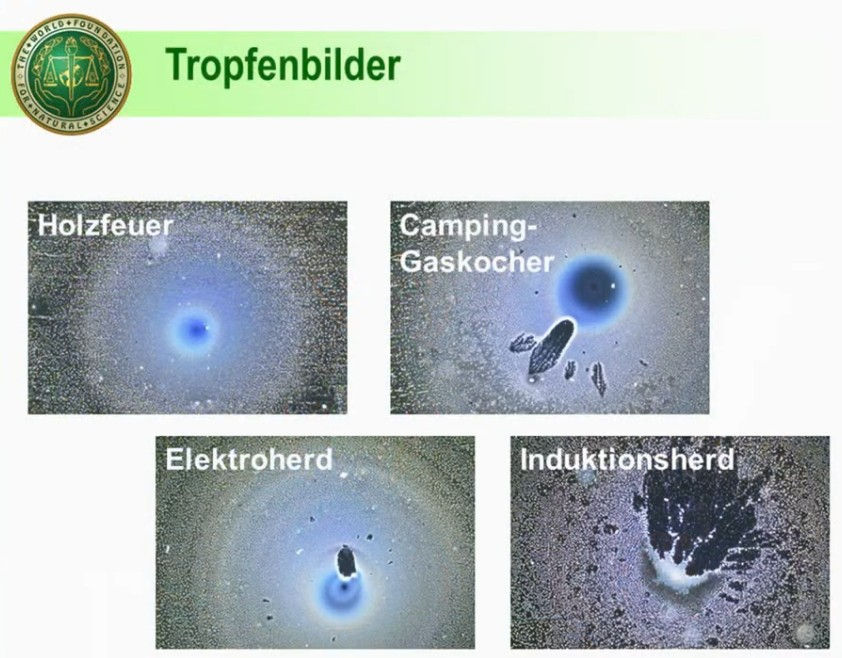
This one has four pictures showing the effects of wood fire (Holzfeuer), camping gas cooker (Camping-Gaskocher), an electric stove (Elekroherd), and the induction stove (Induktionherd).
As can be clearly seen, the best structure can be seen when wood was used. The water drop structure was relatively unchanged when gas or electric stoves were used. When the induction stove was used the drop structure looks like as if it exploded.
The above included pictures are one thing. The other important aspect is the flavor of foods cooked on induction ovens.
A good example of that would be one of our customers who cooks a lot and enjoys cooking.
One day, after moving to a new apartment, she came over to our place and she had a problem.
She said that she can not understand why all of the sudden her food does not taste right. Ever since she moved, the same dishes that she always made, taste different now.
She even pointed that the food tastes as if it was dead. So, we asked her what is she using for cooking. And it was the induction oven that she was now using.
Before moving, she had a gas stove. And that was the only difference.
Right after our conversation, she changed the induction stove for an electric one, and food started tasting a lot better.
This is also the reason why good restaurants do not want to use induction ovens, as there' s a big difference in the way foods taste when cooked on them.
To find out even more on the topic of induction ovens and what effects they can have on foods (water included) and on people using them, please check this great video which is posted on website of The World Foundation for Natural Science.
It is titled "Induction Hobs - Danger to Our Health" and it was presented at the 22nd International “New Scientific Outlook“ World Congress, in Ulm, Germany, on November 2nd to November 5th 2017.
This video has two parts. The first one explains in detail how induction oven work, and the second part explains their effect on food and on people who use them.
The presentation is in German, but English subtitles are available.
All pictures marked with (*) come from the above mentioned video presentation.


Kommentare